
May 2, 2017

The Top 10 Reasons I Love JV - Part 2

Hello again! I’m currently in the middle of sharing my top 10 reasons for loving Josiah Venture. If you haven’t read the beginning of this, the first 5 of these reasons are located here.

After being involved in the organization since 1997, first as a JV kid, then as a summer intern, and now as a full-time staff member, I’ll warn you that I am far from being impartial and the opinions included in this article are anything but neutral.

That being said, I love JV and think you should too. Here are the last of my top 10 reasons why.

6) JV is about God-honoring excellence. Working in the main office here in the Czech Republic has given me a behind the scenes look into the effort that goes into all that JV does throughout the 13 countries we work in. I now have a greater appreciation for the desire our staff members have to do everything with God-honoring excellence, which is one of our 5 core values. As a non-profit organization, JV wants to be professional in conduct, taking the time needed to create training resources and ministry tools that are effective. We pay attention to the small details at camps and conferences, working toward meeting high standards of quality in everything we do. But JV does this not to succeed in the eyes of the world, but to honor God and pursue His kingdom here in Europe. As a self-proclaimed perfectionist, I am thankful to serve in an organization that strives to do things well, but I’m even more grateful for the reminder that the standards we are striving for are set by God and the reason we pursue them is to glorify Him, and Him alone.

7) JV is about dreaming big. Whether entertaining ideas about an online prayer chain to get people around the world to pray for what God is doing here in Europe or planning expansions for our Malenovice Event Center so that we can equip more leaders each year, Josiah Venture welcomes big dreams. Everyone who knows JV at all knows Dave Patty, the president, is a visionary who is often imagining what God might do in the future. After over 20 years, he is still dreaming and now has a large team behind him who dreams big as well, seeing potential in how things could be, instead of just how they are. I’m happy to be included in that group.

8) JV is about bold faith. This goes with reason number 7, but not only does JV dream big, JV is a group of people who aren’t afraid to step out in faith in order to make those dreams a reality. This is why bold faith is another one of our core values. I’ve seen this modeled numerous times throughout the years, beginning in my own home where my parents moved our family of five overseas twice and showed me that taking the chance to trust God, even when it’s scary or seems impractical and risky, is always worth it. These days, I’m loving getting to hear about all the new and innovative ways JV missionaries are using the gifts and opportunities God’s given them to walk bravely forward in ministry. Some have had crazy discussions with public school or government officials, others have risked sounding like fools in a foreign language, others have committed to buying houses here and settling down even without being married, and others have started entirely new ministries within JV. No matter what, I work with people who are strong and courageous, because they hold onto God’s promise to be with them wherever they go.

9) JV is about family. This is nearing my absolute favorite thing about JV. I honestly have no idea how JV has managed to keep its DNA the same even as it grows, but I’m super glad it has. When my family first arrived in Poland in the 90s, the JV team was only a small group of families living in two countries. We would celebrate Thanksgiving in one room in someone’s house and would have gift exchanges at Christmas time. We were a tight-knit group sharing the same heart for Christ and the youth of post-communist Europe. Today, we’ve outgrown our Malenovice training center in Czech and I can’t always remember everyone’s names. We’re more spread out, which means I don’t see friends I wish I could see very often, maybe only once or twice a year. And keeping up with all that’s going on within the organization is a difficult task, even with technology to help us. But, whether I’m just having lunch at my place with a fellow team member or worshipping alongside the whole group in our tent at a conference, this community still feels like home. JV has always been about relationships, first and foremost, and I’m so grateful that throughout the years, and with plenty of growth, that’s continued to be the case. I find it an absolute privilege to serve alongside the JV staff.

10) JV is about a movement of God. Most importantly, I love JV because it is so clear to me that God is at work here. When I get to conduct interviews with people whose lives have changed drastically because of the gospel, I know that He’s present. When I sit in the office with six other communications team members so swamped with work projects that it is obvious we need more workers, I’m aware that the growing pains means God is moving. He’s in the middle of a great and mighty work that He’s invited us into. And although it’s far from finished, the stories of the past make me even more excited about what is to come. Our vision as Josiah Venture is to see a movement of God among the youth of Central and Eastern Europe that finds its home in the local church and transforms society. This is what we pray for, what we work towards, what we’ve committed ourselves to, but we know this isn’t about us. God is big and good and loves young people here more than we ever could. We’re just happy to be witnesses as He proves it to them.

So, there you have it. These are just the top 10 reasons I love JV. What are yours?
Related Posts

Read Story

Events, Stories

The Right Learning for the Right Person at the Right Time

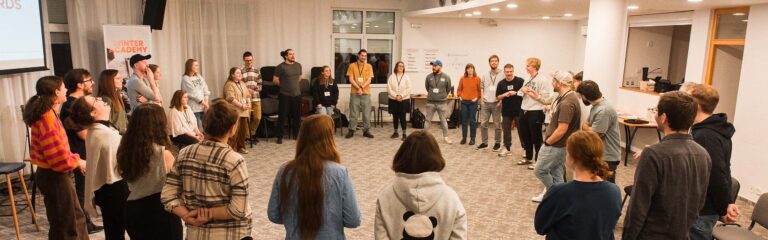
Stop and think about the times in your life when you grew the most. What were you doing? What were the circumstances? What did you feel? What were you excited about, and what were you worried about? When I look back on my own life, I notice a pattern. Growth usually happens when the challenge in front of us is outside of our comfort zone or outside of our skill level. It happens when we’re stretched. I remember learning this in a very tangible way in college. I took a class called Experiential Learning, and, throughout the semester, we worked through various team-building exercises. At the end of the course, we went to a ropes course, which culminated in a challenge known as the “Pamper Pole”—a towering 10-meter telephone pole. The challenge was to climb to the top, stand on a tiny platform, and then leap to grab a trapeze bar. My professor had seen me go through most of the challenges fairly easily. Just as I was about to climb the Pamper Pole, he quietly walked up behind me, put something in my back pocket, and said, “Just in case you want a little bit bigger challenge.” I reached inside and found a blindfold. And I decided to put it on. I climbed the pole blindfolded, made it to the top, and then jumped. My hands hit the bar, but I didn’t grab it. Of course, I was strapped in, so I didn’t hit the ground, but that moment has stayed with me. Even though I didn’t “succeed” in the way I had hoped, I chose a harder pathway up, and I learned something important: growth often requires stepping into something beyond what we currently know how to do. The missionary life is a lot like that. When Brooke and I first stepped onto the mission field, we were eager and ready to say yes to whatever God put in front of us. We had vision, enthusiasm, and a desire to serve. But looking back, we didn’t realize how steep the learning curve would be or how much God still needed to form in us. Those early years were full of trial and error. We made countless mistakes and learned by trying something, realizing it didn’t work, and trying again. Over time, the Lord shaped us and grew us, but the learning curve was long. Some of the lessons we needed most came through hard seasons, and they didn’t come quickly. The Josiah Venture Winter Academy was established to help provide the resources necessary to give our staff a foundation for healthy, effective ministry that lasts, grounded in Christ’s strategy, and strengthened by shared language, practical tools, and a community that helps them grow through every season. This year, we gathered 52 Josiah Venture staff at our training center in Malenovice, Czech Republic, for a week of discussion, connection, and spiritual encouragement. Every staff member has the opportunity to participate in Winter Academy within their first year on the team (Year 1 track) and again within their second year (Year 2 track). At its core, Winter Academy is about helping our staff build a foundation that will serve them for the long haul, so they can be steady and fruitful through the ups and downs of ministry. Ministry is full of seasons. There are times of blossoming, when the work feels joyful and full of momentum, and there are times of drought, when setbacks and discouragement threaten to parch the soul. Some seasons even hold those highs and lows at the same time. Jeremiah 17:7–8 reads: “Blessed is the one who trusts in the Lord, whose confidence is in him. They will be like a tree planted by the water that sends out its roots by the stream. It does not fear when heat comes; its leaves are always green. It has no worries in a year of drought and never fails to bear fruit.” These verses don’t deny hardship; they assume it. But it also points us to the keys to long-term fruitfulness: staying rooted and drawing consistently from the resources we have in Christ. Winter Academy was created to help staff establish those roots early. We wanted to shorten the learning curve so that new staff would be prepared for the obstacles they would inevitably face, and so they could respond with bold faith, with wisdom drawn from best practices across the team, and with perseverance, knowing they would have a team standing with them. Year 1 focuses on the path of a growing disciple. Our first-year staff get grounded in who we are as Josiah Venture and how Christ’s strategy shapes everything we do. They also learn the Five Challenges of Christ in a way that moves beyond theory into real life and real ministry. Year 2 is focused on ministry coaching through the Five Phases. Year 2 builds on that discipleship foundation and helps our staff grow in how they serve and multiply through others. Participants learn how to evaluate ministry health and direction as well as practice coaching conversations that help leaders take meaningful next steps. Once our staff complete Winter Academy (Years 1 and 2), we want them to know three things with certainty: I am not alone. I know who to turn to for help. I look to Jesus as my model for ministry. We’re grateful for what God has done through Winter Academy over the years, and we invite you to join us in praying that this event continues to deepen roots, strengthen faith, and produce fruit that lasts.

Read Story

Stories

Christmas Traditions

Every culture has its own Christmas traditions. Many of us already have our Christmas trees up, have begun playing our favourite Christmas music, and are checking items off our shopping list. In most European cities, Christmas markets have taken over town squares and observe their own unique traditions for Christmas Day. For example, in Poland, families prepare an extra place at the table in case of an unexpected guest; in Bulgaria, the oldest person in the house breaks open homemade bread with a coin baked inside; and in Czechia, children hide a fish scale under their dinner plate for good luck. Traditions are a wonderful thing as long as we remind ourselves why we keep them. One tradition that has meant a lot to my family and me for many years is lighting an Advent wreath. We usually make ours out of fir branches and four white candles, sometimes adding extra decorations like dried orange slices or pinecones. Then on the four Sundays leading up to Christmas, we read from the Bible, say prayers, sing songs, and light the candles in an increasing number: first one, then two, then three, and finally four. This tradition has its origins in the sixth century, and many European churches and Christians practice it. But after such a long time, it is easy to forget what it all means. Here is some of the significance. First of all, Advent derives from the Latin word for “coming, arrival.” It denotes the beginning of the year for Christians, who prepare our hearts for the arrival of God, by both remembering Jesus’ incarnation and anticipating his second coming. The circular shape of the wreath signifies the never-ending nature of God’s love for humanity. The fir branches remind us that, even in the dead of winter, God is at work to bring forth new life. And the successive lighting of the candles signals God’s determination to send his light into the world: the incarnation of his son. We love this tradition, but, to be honest, we don’t always keep it perfectly. This year, we had to dig out some old candles to use for our wreath, we have struggled to get through the Bible readings with our young children, and we often forget to light the right candle on the right day. But God is teaching me that this is alright. The season of Advent, along with its many traditions, is not made more or less meaningful by how faithfully I keep it. The season of Advent is made most meaningful because of how faithful God is at drawing near to us. The Apostle Paul summarised it well: “But when the right time finally came, God sent his own Son… so that we might become God’s children.” (Gal. 4:4-5, GNT). This Advent, may you find renewed meaning in your traditions. And may you remember and rely on God, who is most faithful to draw near to those who need his light.

Read Story

Discipleship, Evangelism, Stories

Home

Sajmir just wanted to belong. As the youngest son in a Muslim family of eight children, he was expected to serve everyone. Sajmir’s family was oppressed in Albania because they were dark skinned Gypsies. On top of that, during the difficult time after the revolution, his father began drinking and beating his mother. “My father never beat me,” Sajmir said, “but he never showed me love. He never hugged me or kissed me. I never saw a father figure. I was afraid of him. Also, outside in the city, people were not very close to me. I spent most of my time alone, playing soccer alone, or basketball alone.” There was only one soccer field in his village, and when Sajmir tried to join a game, the other kids would kick him out. One day, a group came toward the field and Sajmir began to back away, sure they would ask him to leave. “Will you play with us?” they asked. “You want to play with me?” Sajmir replied. For the first time in his life, someone invited him in. After the game, they invited him to church. “What is a church?” he said. Running home, he asked his parents if he could go. “Don’t go to church,” they answered sternly, “you will shame us.” But the next day was Sunday, and he snuck out when no one was looking. “When I stepped into the church, at the door, someone gave me a hug for the first time in my life,” Sajmir said. “They put me in the first row. I felt like a celebrity. Then I heard the story that someone loves you just as you are, that is, Jesus—as I was, dark skinned, rejected. But still, there is someone who died for me.” “I ran and told my family, but their response was: ’If you go one more time, we will tell your brother to beat you up.’ I went again. My brother beat me up. For three months, I was beaten every week. I was loved and accepted in church, while suffering and being beaten in my family. Then my mom said, ‘Let him go.’” Filled with joy, Sajmir fell on his knees and said, “God, I will serve you wherever you want me to.” That was 25 years ago, and today Sajmir and his family are part of our Josiah Venture team in Albania. Through youth ministry, he recently planted a church called “Mosaic,” which has grown to over 100 people. Every day, young people come after school and in the evening for tutoring, children’s meetings, youth meetings, small groups, discipleship groups, and a very lively Fusion choir. The church is open every day, from 9:00 am to 7:00 pm, and there is always something happening. “Our building is a daily home for everyone; it’s a family,” says Sajmir. “I always remember what God did for me in my youth. My heart is burning to see more young people come to Christ and find that they are loved and belong.” During this Advent season, we remember how Jesus left his home to make a home for us. He was sent to find us, where we play our games alone, and to invite us into his family. He found Sajmir, and you, and me. Thanks for helping us share this good news with young people who are still without a home. Dave Patty President, Josiah Venture