
October 11, 2016

The Road to Croatia - A New Missionary Story

Walking Forward

“I had been floundering, trying to figure out what to do with my life. I had finished my first year of college and had never considered ministry as an option. But I had been pushed by a JV team leader to come back as an intern, and everything about it made sense and was exciting to me.”

Bronwen Crowley first went to Croatia with a short-term team from a Phoenix church in 2009 at age 19. After connecting with people there, she returned the next two summers as a JV intern.

Meanwhile, her future husband, Evan, was working with Habitat for Humanity in Seattle when he checked out Josiah Venture on a mentor’s recommendation. “All I could sense from the Spirit was be available, be obedient, and walk in the direction I have for you.”

At the time, our greatest need for interns was in Slovenia, so in the summer of 2011, Evan interned there while Bronwen served across the border in Croatia. The two met during intern training, which they now jokingly call, “that romantic Amazing Race.”

Fully Surrendering

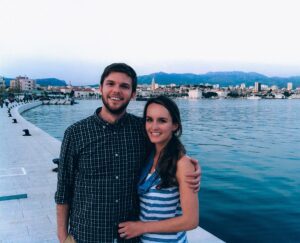
After getting married in 2014, the Crowleys are now JV missionaries in training (MITs), raising support and getting ready to serve full-time in Croatia, where two other families are already heading up ministry in Split.

When asked what they love about Josiah Venture, Bronwen says, “Prioritizing the local church. Prioritizing spiritual health among missionaries –we saw that big time even in the care we received before being accepted as full-time JV missionaries. And being gospel-centered and excited about what God is doing in these countries.”

Evan goes on to describe why they are heading to Croatia. “God brought us to a place of full surrender. We both had different backgrounds. We didn’t know: ‘God do you want us to head to Slovenia? Do you want us to go to Croatia? Do you want us to go to either?’ So he brought us in a very kind way to surrender. ‘Anywhere you are leading us, God, we want to go. As a couple, unified, together. We understand that you have put these experiences in our past, we’re desperate for your vision for the future.’”

During a trip to Europe in 2015, God spoke through His word in a way that Evan describes as “powerful, direct, and clear.” On Christmas eve, the Crowleys were officially accepted by the organization and were able to start the process of getting overseas.
croatia couple

Anticipating the Future

The road to Croatia has taken a lot of preparation.

In February, the couple attended JV’s new missionary orientation at the office in Wheaton, IL. Taking place twice a year, every February and October, the 3-4 days are designed to help our new staff with financial and HR logistics while also communicating more of the vision and mission of JV.

Bronwen says, “The overarching thing that stood out about orientation was meeting other missionaries going with Josiah Venture. I think we were all eager to make friends so it was a really good platform for that. It was also a good opportunity to get to know the people who are serving with JV full-time in the States, because we have so much online communication with them now it’s just good to know their hearts.”

Since completing orientation, the couple has raised over 70% of their support, resigned from their jobs, and are currently in Colorado for a month-long program at Missionary Training International, a required time of language acquisition and cross-cultural training that all our American JV missionaries attend before moving to Europe.

While training is obviously part of becoming equipped for their position in ministry, the MITs say that everything else about the process is preparing them as well.

Evan says he was reading a devotional book the other day and “it talked about how God is ultimately our great supporter. It meant that you can lean into Him, but it came at just the right time. God is our great supporter as we are seeking all these other supporters.”

Bronwen adds, “Support raising is teaching us bold faith. With the same boldness we are asking people to support us, we’ll be proclaiming the gospel in Croatia. It’s the same, asking people to change their lives and reorder their priorities, with support raising or with following Jesus.”

The couple is also learning to trust God in the letting go process. Evan explains, “It’s been, in a sense, this consistent level of stress doing the work of support raising, but now that stress has turned to an underlying level of grief, because we’ve been working towards this goal and now we’re beginning to say goodbyes. Not only goodbyes to people, but we’re saying goodbye to our apartment and our city.”

Even with the personal sacrifice and challenges, the Crowleys know the process is worth it. Bronwen says, “We believe so heavily in this vision and in discipling young people in Croatia.” Moving to a country of 4.5 million people where only .4 percent identify themselves as evangelicals, these new missionaries will surely have plenty of opportunities to share the hope of the gospel.

The MITs look forward to the day when they arrive on the field and are able to invest in the people of Croatia. Evan says, “Our perspective right now is in general terms. We don’t really know Croatians. So the idea of learning about them, learning from them, learning with them is really exciting because that’s going to help us discover avenues for the gospel that are going to be effective.”

Please join us as we pray God would continue to lead and provide for Evan and Bronwen, and all our missionaries in training, as they work towards serving with JV full-time.

Amy Nickerson

Related Posts

Read Story

Stories

A Thanksgiving Challenge and Promise

Philippians 4:4-7 states, “Rejoice in the Lord always; again I will say, rejoice. Let your reasonableness be known to everyone. The Lord is at hand; do not be anxious about anything, but in everything by prayer and supplication with thanksgiving let your requests be made known to God. And the peace of God, which surpasses all understanding, will guard your hearts and your minds in Christ Jesus.” Two things stand out to me from this verse: a challenge and a promise. The Challenge: Christians are commanded to not be anxious about anything. Instead, we are to be thankful. Paul wrote this letter as he was in prison, preparing for his martyrdom. He acknowledged that his entire ministry was in the Lord’s power and he had nothing to be anxious about. Furthermore, his friends were not supposed to be anxious either. Rather, they were to thank the Lord for his provision and truth. In this situation, Paul was not instructing his friends to deny that there was hardship. He admitted that there would be pain in the future. However, with that, the Church was to devote all troubles to the Lord. How would this play out in a modern Thanksgiving Day context? Jenny Llamas was born in the Czech Republic, so she did not grow up with Thanksgiving. Landen, her American husband, did and has had so much fun introducing the holiday to her. From American football to turkey trots to sweet potato casserole with marshmallows, Landen and Jenny love getting to spend Thanksgiving either with their family or at Josiah Venture’s conference center in Malenovice, Czech with Josiah Venture missionaries. One challenge for Jenny, though, has been when people are asked to share what they are thankful for. It’s not the mental search for thankfulness that’s difficult for Jenny. Instead, it’s all the other thoughts that come to her mind too. It’s “the hard things in my life that sometimes even seem louder than the things I’m thankful for,” Jenny said. During these times, she wants to find ways to process and acknowledge times of hardship while also remaining thankful. So, how does Jenny do that when she is reminded of hard times during Thanksgiving? How does she process both pain and thankfulness? Jenny’s favorite part of Thanksgiving is the meal preparation. She has her own quiet time in the kitchen. As she experiments with all sorts of traditional American recipes, she reflects on how God has worked in her life over the past year. She recalls the exciting times of blossoming relationships with friends and the painful memories of things uncertain and hurtful. It’s in these moments that Jenny brings everything to God, both the good and the bad. That’s where the promise of Philippians comes into play. The Promise: In response to giving thanks, the Lord will surround us with his peace. When we submit to the Lord in thanksgiving, he places a spiritual shield around our hearts and minds. He takes us out of a state of fear and provides us with the ability to give thanks in all circumstances. When the meal preparation is complete and Jenny steps out to celebrate with friends, she reminds herself that God wants her to have peace. God has given her a spiritual family with whom she can process heartache and pain. He also provides her with the time to journal, writing down her thoughts as a way of acknowledging hardship and giving it to the Lord. Then, he gives her rest. “I say a quick prayer to the God who sees me,” she said. “I give myself permission to rejoice in what God has done and … take a break from the hard things knowing that God sees them and he holds them.” This Thanksgiving, I invite you to recognize the trials in your life and give them over completely to God. Replace the state of anxiety with the action of thankfulness, preparing your heart for worship as we enter into this holiday season. “The Lord is at hand.” (Phil. 4:5b)

Read Story

Events, Stories

You’re Not Alone in the Battle

When you’re used to leading, serving, and pouring into others, what happens when you suddenly can’t? What happens when the person who normally encourages everyone else wakes up and realizes she has nothing left to give? That’s where I found myself last year. I’m naturally a driven person. I love to see progress—to watch people grow, ministries flourish, and God’s work move forward. But last year, right before a major conference I had been preparing for—a mental health summit for nearly 700 youth leaders and church leaders—everything stopped. I got sick, and my normal pace of life vanished overnight. Suddenly, I couldn’t do what I thought I had to do. At first, I tried to stay positive, to find purpose in the pause. I told myself God was teaching me patience, humility, or to delegate better. But underneath those thoughts, a more dangerous narrative started to form: “God is disappointed in you.” “You’re not strong enough.” “You’re failing as a leader.” “Maybe God is holding back because you don’t deserve his help.” Those are the kinds of lies that can take root quietly—and quickly. It’s the same old whisper the enemy used in the Garden: “Did God really say…?” (Genesis 3:1). The serpent’s goal was never just to tempt Eve; it was to make her question God’s heart. And he still uses that same strategy today. He wants us to believe that God is distant, that we’re alone, unseen, and unloved. I’ve seen this pattern not only in my life, but in the lives of so many young people and leaders I’ve walked with. The moment things get hard—disappointment, exhaustion, relational conflict, failure—the enemy twists the truth. He tells us we’re forgotten, that our prayers don’t matter, and that no one really understands. And slowly, we start to isolate ourselves. But isolation is one of his most effective weapons. Once we withdraw, our vision blurs. We stop hearing the truth clearly. We start interpreting everything through the lens of fear, shame, and self-pity. Even Scripture is full of people who felt this same ache. David cried, “Turn to me and be gracious to me, for I am lonely and afflicted” (Psalm 25:16). Elijah, after a great victory, ran into the wilderness and said, “I have had enough, Lord” (1 Kings 19:4). Job sat surrounded by friends who misunderstood him. And even Jesus—our Savior—experienced complete abandonment in Gethsemane and on the cross. Loneliness and lies are not new, but neither is God’s response to them. In my own season of weakness, when I couldn’t find the strength to pray, others prayed for me. When I felt unseen, people showed up with meals, with text messages, and with quiet presence. Even my unbelieving neighbors said, “We think someone up there cares about you.” That was God reminding me: You are not forgotten. You are not alone. The truth is, the Body of Christ was never meant to function in isolation. Strength in God’s kingdom doesn’t mean independence—it means connection. It means letting others carry you when you can’t walk and trusting that God is at work even when you can’t see progress. This experience also helped me recognize a pattern: the enemy always attacks identity and connection first. He wants to disconnect us from God’s truth and from God’s people. But the way we stand firm is by returning to both. When I start to spiral now—when I believe I have to prove my worth or carry everything alone—I stop and remind myself of what’s true. I reach out to trusted friends and ask for prayer. I ground myself in simple spiritual and physical practices that bring me back to reality: breathing deeply, reading a psalm, or stepping outside to notice beauty. These small moments become declarations of faith. Romans 11:33-36 says, “Oh, how great are God’s riches and wisdom and knowledge! How impossible it is for us to understand his decisions and his ways!” That verse anchors me. I don’t have to understand everything; I just have to trust the one who does. Maybe you’re in a similar place right now. Or maybe you’re walking with young people who feel lost, invisible, or stuck in lies about who they are. The battle is real, but so is our victory in Christ. So, here’s my invitation to you: Would you take a moment to pray—for yourself, for your friends, and for the next generation—that we would recognize the lies of isolation, stand firm in truth, and live connected as the Body of Christ? You’re not alone in the battle. And neither are they.

Read Story

Missionary Kids, Stories

Heroes of Faith

Dear Friends, Faith has an unexpected ripple effect. In October of 1955, a 27-year-old woman named Margaret Olsen boarded a Norwegian freighter bound for the Philippines. While a grad student at Bible college, she heard a young missionary named Dick speak about his ministry to the military. Over the next couple of years, she saw him again at a few conferences and was later invited to visit him, along with her mom, for a week as his ship was delayed. He was moving to Subic Bay, Philippines, to establish a ministry to U.S. sailors stationed there after the war. After this brief time together, they continued to communicate through letters, and then a tape came in the mail with a marriage proposal. After prayer and counsel, Margaret accepted, and now she was on her way to marry him. It was a huge step of faith. Her future husband was far away, and so much was unknown. Before leaving, she had managed to gather just $150 in monthly support and donations of supplies for the new servicemen’s center Dick had opened. Standing with her dad and nephew beside the ship, she clutched a portable Singer sewing machine that provided her passage. It was an unusual ticket, but the captain of the ship had agreed to take on one more passenger if she would work her way across the ocean, mending uniforms, bedding, and flags, washing dishes, and scrubbing floors. Before this bold change of direction, she worked a steady job as a registered nurse. But when she gave her life to Christ at the age of 12, Margaret decided that following Jesus wherever he led was worth more than safety, stability, or a career. Now she headed into challenge and uncertainty, anchored only by the promises of God. Two weeks after they were married, she was learning to cook as she fed 60 hungry Sailors who gathered in their home for food and Bible study. It was more difficult than she imagined, yet her steady faith enabled her to view the challenges of long hours of work, heat, and an unfamiliar culture through the lens of God’s sovereignty and loving care. Six years later, I was born in the Philippines, the second child of Dick and Margaret Patty. Throughout my early years as a child, I was surrounded by fruitful ministry to the military. Then, our family moved to Denver as my dad became the director of the mission. In each of these places, daily examples of a life of faith filled our home. Courage, trust, thankfulness, sacrifice, and investment in the lives of others were consistently demonstrated through small acts of kindness and large steps of obedience. A year ago this month, my mom graduated to Glory at the age of 96, preceded just three years earlier by my dad. As I reflect on her passing, I think of the 27-year-old holding a sewing machine as she boarded a ship, confident in the future because she trusted in Jesus. And I realize that Josiah Venture would not exist today if it were not for that young woman’s example of faith. Many of you are also quiet heroes. What unexpected impact is rippling out of your steps of faith? Grateful for each of you, Dave Patty President, Josiah Venture