
October 26, 2016

Like a Skyscraper - Hungary Spotlight

“God has already saved Europe twice. We’re asking Him to do it a third time.”

Dávid, a Hungarian Christian, sat face-to-face with Rob Trenckmann and smiled as he shared his prayer for revival with the soon-to-be Josiah Venture missionary.

As the two discussed how God had transformed Europe first in the early centuries after Christ, and then again during the Reformation, Rob was drawn to Dávid’s deep trust in God and his passion for seeing a renewal of faith in the country of Hungary –a country that was once known as a central power of Europe.

Laying the Foundation

In April 2012, in part because of this conversation with Dávid, Rob and his wife Liz accepted the position as JV team leaders and moved their family to Hungary to start Josiah Venture’s ministry there.

Rob describes the first years of working in Hungary as laying a foundation at a construction site. “I heard a story the other day about someone who watched a skyscraper being built. He drove past it every day on his way to work. For the first six months or a year, there were building crews there but it didn’t look like they had built anything. Finally he stopped and looked over the fence, and he said it looked like they had dug about as far down as they wanted to build up, because it had to have that kind of foundation. I feel like that’s what the first years were for us… a lot of foundation work.”

This foundation building is crucial for ministry, but it isn’t easy. The Trenckmanns faced personal challenges including multiple moves, theft, and serious health issues all before having any team members join them.

Another obstacle were the feelings of disloyalty and hopelessness that lace Hungarian society. In recent history, Hungarians have seen over 70% of their territory and ⅓ of their population taken away from them. On top of this, a dead, legalistic form of catholicism prevails across the region. Rob says that because of these factors, making connections with Hungarians and the local church has taken time.
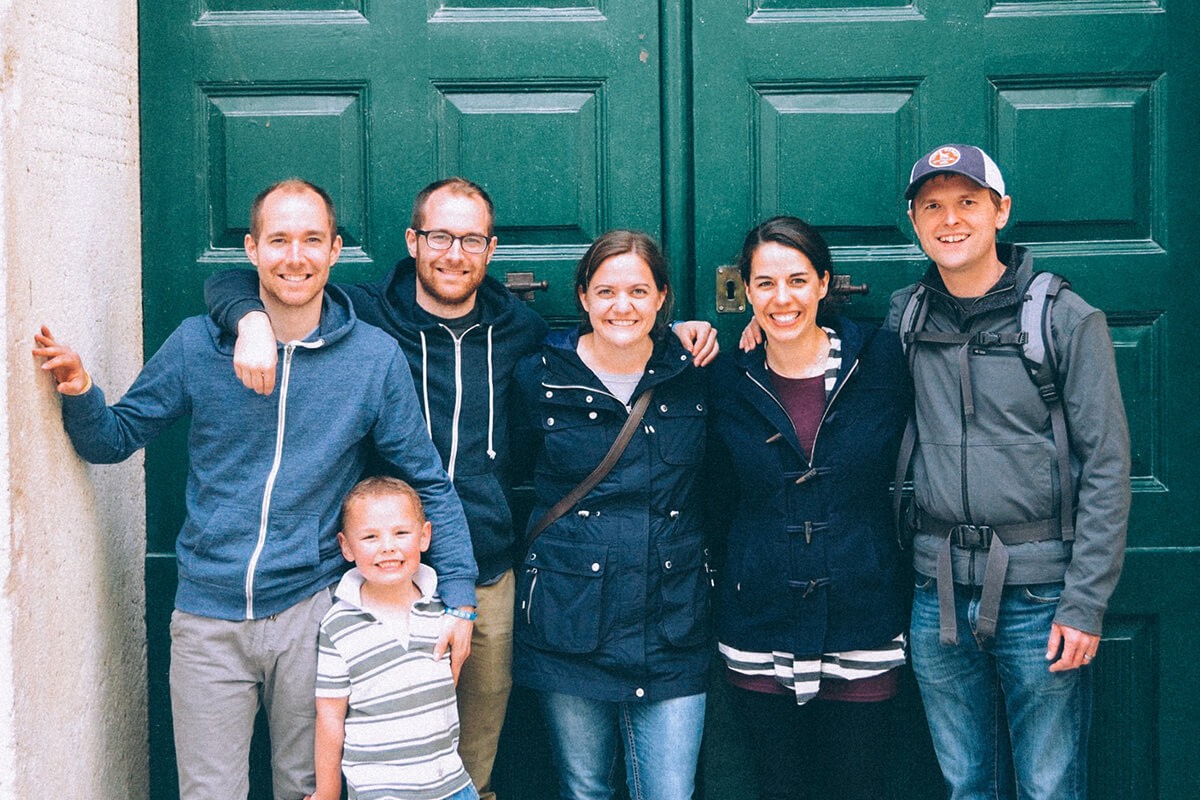
missionary team

The JV Hungary team is excited about what God continues to do as they are faithful in ministry.


Building Upward

Yet, in time, the foundation has been laid and the work is gaining momentum.

Now four years after the Trenckmanns moved to Hungary, the JV team has expanded to include three other North American staff members, as well as one in the process of raising support. The team has also recently welcomed their first Hungarian member and are in the process of setting up a national organization.

What started in one city and one church has spread to two cities and three churches, with the goal to be in three cities, five churches soon.

Liz Trenckmann expresses her excitement, saying that one of the biggest things she’s learned is that “it’s about coming together on a team and being a unified body that is moving in the same direction. It’s through that that we see people come to Christ.”

Rob describes the effects of this further, “We’re seeing relationships we’ve been invested in for a while bear fruit. Both of the youth ministries we are involved with in Veszprem have new believers in them that have come to Christ through youth group, Edge sports, or camp. And those new believers, both guys and gals, are then plugging into small groups and reading the Bible with other people. And there are also some kids who grew up in the church, who weren’t doing well spiritually a year ago, who are now excited about their faith and leading their friends to Christ. It’s fun to see lights go on for the values of making disciples in the model of Christ.”

Future Work

As Rob and Dávid discussed years ago, the prayer remains: “We’d love to see a young generation grow up in Hungary that not only leads their country back to Christ, but has an impact on the entire region.” And the team continues to follow God with bold faith toward this end.

Rob states, “We’re seeing God work. And my sense is that we’re about to see even more of the above ground work happen. The best is yet to come.”

Please pray with our Hungary team that God would provide more workers, partnerships, and resources so that the ministry can continue to expand and the skyscraper that has begun taking shape will be built up and one day come to completion. 

Amy Nickerson

Related Posts

Read Story

Events, Stories

The Right Learning for the Right Person at the Right Time

Stop and think about the times in your life when you grew the most. What were you doing? What were the circumstances? What did you feel? What were you excited about, and what were you worried about? When I look back on my own life, I notice a pattern. Growth usually happens when the challenge in front of us is outside of our comfort zone or outside of our skill level. It happens when we’re stretched. I remember learning this in a very tangible way in college. I took a class called Experiential Learning, and, throughout the semester, we worked through various team-building exercises. At the end of the course, we went to a ropes course, which culminated in a challenge known as the “Pamper Pole”—a towering 10-meter telephone pole. The challenge was to climb to the top, stand on a tiny platform, and then leap to grab a trapeze bar. My professor had seen me go through most of the challenges fairly easily. Just as I was about to climb the Pamper Pole, he quietly walked up behind me, put something in my back pocket, and said, “Just in case you want a little bit bigger challenge.” I reached inside and found a blindfold. And I decided to put it on. I climbed the pole blindfolded, made it to the top, and then jumped. My hands hit the bar, but I didn’t grab it. Of course, I was strapped in, so I didn’t hit the ground, but that moment has stayed with me. Even though I didn’t “succeed” in the way I had hoped, I chose a harder pathway up, and I learned something important: growth often requires stepping into something beyond what we currently know how to do. The missionary life is a lot like that. When Brooke and I first stepped onto the mission field, we were eager and ready to say yes to whatever God put in front of us. We had vision, enthusiasm, and a desire to serve. But looking back, we didn’t realize how steep the learning curve would be or how much God still needed to form in us. Those early years were full of trial and error. We made countless mistakes and learned by trying something, realizing it didn’t work, and trying again. Over time, the Lord shaped us and grew us, but the learning curve was long. Some of the lessons we needed most came through hard seasons, and they didn’t come quickly. The Josiah Venture Winter Academy was established to help provide the resources necessary to give our staff a foundation for healthy, effective ministry that lasts, grounded in Christ’s strategy, and strengthened by shared language, practical tools, and a community that helps them grow through every season. This year, we gathered 52 Josiah Venture staff at our training center in Malenovice, Czech Republic, for a week of discussion, connection, and spiritual encouragement. Every staff member has the opportunity to participate in Winter Academy within their first year on the team (Year 1 track) and again within their second year (Year 2 track). At its core, Winter Academy is about helping our staff build a foundation that will serve them for the long haul, so they can be steady and fruitful through the ups and downs of ministry. Ministry is full of seasons. There are times of blossoming, when the work feels joyful and full of momentum, and there are times of drought, when setbacks and discouragement threaten to parch the soul. Some seasons even hold those highs and lows at the same time. Jeremiah 17:7–8 reads: “Blessed is the one who trusts in the Lord, whose confidence is in him. They will be like a tree planted by the water that sends out its roots by the stream. It does not fear when heat comes; its leaves are always green. It has no worries in a year of drought and never fails to bear fruit.” These verses don’t deny hardship; they assume it. But it also points us to the keys to long-term fruitfulness: staying rooted and drawing consistently from the resources we have in Christ. Winter Academy was created to help staff establish those roots early. We wanted to shorten the learning curve so that new staff would be prepared for the obstacles they would inevitably face, and so they could respond with bold faith, with wisdom drawn from best practices across the team, and with perseverance, knowing they would have a team standing with them. Year 1 focuses on the path of a growing disciple. Our first-year staff get grounded in who we are as Josiah Venture and how Christ’s strategy shapes everything we do. They also learn the Five Challenges of Christ in a way that moves beyond theory into real life and real ministry. Year 2 is focused on ministry coaching through the Five Phases. Year 2 builds on that discipleship foundation and helps our staff grow in how they serve and multiply through others. Participants learn how to evaluate ministry health and direction as well as practice coaching conversations that help leaders take meaningful next steps. Once our staff complete Winter Academy (Years 1 and 2), we want them to know three things with certainty: I am not alone. I know who to turn to for help. I look to Jesus as my model for ministry. We’re grateful for what God has done through Winter Academy over the years, and we invite you to join us in praying that this event continues to deepen roots, strengthen faith, and produce fruit that lasts.

Read Story

Evangelism

The Good Shepherd

Is there hope for broken people? Between Christmas and New Year’s, I spent five days with over 100 college students from a student movement here in the Czech Republic. We dug deep into Psalm 23, learning about our Good Shepherd and how to follow him more closely. Most of the students were first-generation believers, often without a single relative who knows Jesus. Between the teaching sessions, I heard their stories, and my heart was heavy for the broken world they grew up in. Honza had very few memories of his dad, except for the unending hateful comments his mom would say about him after they divorced. Later, he realized that almost all of her relationships were broken and characterized by hate and unforgiveness. As he grew older, the hate took root in his heart, primarily directed at himself. He moved through life constantly expecting rejection. Then someone invited him to the student meetings, and he heard about a Father who loved him unconditionally and a Son who bore his sins and pain on the cross. In faith, he believed the words of Isaiah 53, that “with his stripes we are healed,” and placed his rejection and wounds on Jesus. The Good Shepherd found him, and now he is pioneering the student ministry in a new city, sharing the good news of redemption with many who have never heard. Lucy’s dad was a person with alcoholism who turned violent whenever he had too much to drink. As a small child, Lucy would cower in the corner as her dad physically abused her mom, at times fearing that her mom would not survive the beatings. He took his anger out on the kids as well, and she would go to school with bruises on her face and body. When the teachers asked what had happened, Lucy made up a story. If she told the truth, another beating would quickly follow. Lucy dreamed about running away forever, or taking her life, because her entire world was so full of danger that she had no hope. Thankfully, in university, a classmate told her about Jesus Christ and his supernatural power to change lives. The good shepherd found her and placed her in a new family. Her eyes filled with tears as she told me about the redemption she had found in Christ and the safety she found in his unending care. Katka told me she had never read the Bible and had just come to the retreat out of curiosity. She had many questions and, on the final day, asked me to sign the book she had just bought about knowing God as Father. “It’s my birthday today,” she said. I’m praying that she will be born again soon. Since the Czech Republic is the most atheistic country on earth, many young people grow up in broken families and become broken people, without hope and a way of escape. But we know the Good Shepherd. Thanks for joining us as we search for his lost sheep. Dave Patty President, Josiah Venture

Read Story

Stories

Christmas Traditions

Every culture has its own Christmas traditions. Many of us already have our Christmas trees up, have begun playing our favourite Christmas music, and are checking items off our shopping list. In most European cities, Christmas markets have taken over town squares and observe their own unique traditions for Christmas Day. For example, in Poland, families prepare an extra place at the table in case of an unexpected guest; in Bulgaria, the oldest person in the house breaks open homemade bread with a coin baked inside; and in Czechia, children hide a fish scale under their dinner plate for good luck. Traditions are a wonderful thing as long as we remind ourselves why we keep them. One tradition that has meant a lot to my family and me for many years is lighting an Advent wreath. We usually make ours out of fir branches and four white candles, sometimes adding extra decorations like dried orange slices or pinecones. Then on the four Sundays leading up to Christmas, we read from the Bible, say prayers, sing songs, and light the candles in an increasing number: first one, then two, then three, and finally four. This tradition has its origins in the sixth century, and many European churches and Christians practice it. But after such a long time, it is easy to forget what it all means. Here is some of the significance. First of all, Advent derives from the Latin word for “coming, arrival.” It denotes the beginning of the year for Christians, who prepare our hearts for the arrival of God, by both remembering Jesus’ incarnation and anticipating his second coming. The circular shape of the wreath signifies the never-ending nature of God’s love for humanity. The fir branches remind us that, even in the dead of winter, God is at work to bring forth new life. And the successive lighting of the candles signals God’s determination to send his light into the world: the incarnation of his son. We love this tradition, but, to be honest, we don’t always keep it perfectly. This year, we had to dig out some old candles to use for our wreath, we have struggled to get through the Bible readings with our young children, and we often forget to light the right candle on the right day. But God is teaching me that this is alright. The season of Advent, along with its many traditions, is not made more or less meaningful by how faithfully I keep it. The season of Advent is made most meaningful because of how faithful God is at drawing near to us. The Apostle Paul summarised it well: “But when the right time finally came, God sent his own Son… so that we might become God’s children.” (Gal. 4:4-5, GNT). This Advent, may you find renewed meaning in your traditions. And may you remember and rely on God, who is most faithful to draw near to those who need his light.