
August 24, 2021

Beyond Hope

What do you do when you lose the thing you’ve been putting your hope in? For so many of us, the events of this past year and a half have forced us to answer that question. Normal activities were cancelled, school was moved online, people were separated from family, and friends, jobs, and businesses were lost; every day there were stories of more sickness and death. In the face of so much loss, it was easy to feel that things were beyond hope.

When Fusion stopped being able to meet, Emi suddenly found herself alone with a lot of time to think. She started developing anxiety that she was too broken and that her past history of toxic friendships, combined with the distance of quarantine, would be too much for her new friendships from Fusion to endure. As a result, she started withdrawing further into herself. She tried making art and music on her own, escaping into books or tv shows, or just sleeping the day away; unfortunately, her anxiety only grew worse. It got so bad that she could barely function, and she began to feel like she would never be able to fix herself. She felt like she was beyond hope.
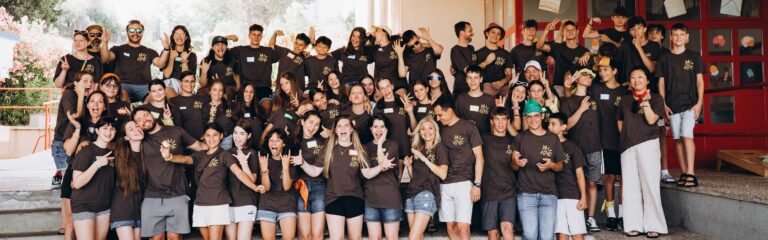
The theme of summer camp this year was “Beyond.” Throughout the week, campers heard talks about how Jesus is beyond our fears, failures, doubts, and dreams. This theme (as well as restrictions, fewer leaders, limited time, etc.) inspired our Fusion team to think “beyond” what our normal end of the week concert could look like. We came up with the idea for a creative dance/pantomime drama set to music that would tell the story of some of the feelings teenagers faced during the pandemic—including how to move forward in a positive way.

We settled on the theme of Hope, who was also the main character in our drama. On her journey, Hope encountered other characters like Loneliness, Anger, and Depression—responses we can all have when we lose the thing we’ve been putting our hope in. At first, Hope was reluctant to help because she feared that if she shared her hope (symbolized by a white flower), she will have nothing left. But, when she finally did share her hope, she discovered that she still had hope within her. The hope she shared with one person soon spread throughout the entire stage until everyone was dancing together.
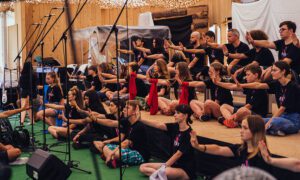
Emi was so excited when she heard the idea for our drama at camp! You see, Emi’s story didn’t end with hopelessness. In fact, she told me at camp that the theme of hope had been so important for her over the past few months.

Earlier this year, Emi realized she couldn’t overcome her anxiety on her own, so she reached out for help. In our weekly meetings, that started out as English/Polish language practice, she started opening up to me about her struggles and her fears. I encouraged her to invite God into those fears through prayer. She reached out to other people who were close to her. She started a regular practice of reading her Bible, praying, and talking about what she was learning. Slowly, she started seeing God clearly answering her prayers for deep, strong friendships. Her faith has been growing ever since. Though she still struggles with anxiety, she knows it doesn’t have control over her life, because she sees now that God is in control.
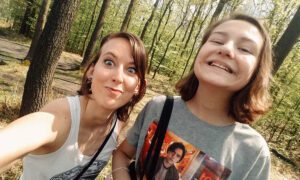
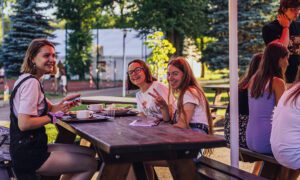
On her own, Emi felt hopeless. But, when others shared their hope with her—the hope we have in Jesus that is not dependent on circumstances or our own goodness or abilities—her life changed for the better. And now she’s able to share that hope with others.

What if “beyond hope” can have a double meaning? Instead of hopelessness, it’s a hope beyond how things appear. Our hope is in a God whose love and faithfulness is beyond measure and who will one day take all of the darkness and brokenness we see in this world and redeem it into something more beautiful than we can imagine. And it’s our task to share in God’s redemptive work—sharing that hope with a hurting world.

Related Posts

Read Story

Events, News, Spotlight

Like Jesus

In a world of endless possibilities, how do you decide what is most important? The battle for your attention is relentless. Every day AI and social media invent more sophisticated methods of force-feeding you information. No wonder you and I feel overwhelmed, since experts tell us that over 90% of the data in the world was created in just the last two years! As the Josiah Venture team has been seeking God’s vision for the next four years, we have narrowed our gaze to ancient truths rather than chasing the latest trends. Our “2030 Vision” brings focused attention to just one priority in the sea of endless possibilities—the simple goal of becoming more like Jesus. Our “Like Jesus” vision has three specific objectives. How can we become more like Jesus in making disciples who make disciples? Paul expressed this priority in his letter to Timothy when he said, “and the things you have heard me say in the presence of many witnesses entrust to reliable people, who will also be qualified to teach others” (2 Tim 2:2). Timothy was an outstanding disciple of Christ, but Paul wanted him to go further and become a disciple-maker, who equipped others to do the same. Disciple-making moves from addition to multiplication when we can see it reaching the fourth generation, as reflected in Paul’s challenge to Timothy. Our first “Like Jesus” focus is to see this fourth-generation disciple-making taking place through all of the 375 members of the JV team. The second “Like Jesus” objective relates to the local youth ministries we are serving. Right now, the JV team is actively partnering with over 650 churches to build disciple-making youth ministries that reach the lost, build believers rooted in Christ, and equip young people to disciple their friends. We do this through training, coaching, events, and powerful outreach tools throughout 16 countries of Central and Eastern Europe. Our vision is to double this number by 2030, walking alongside 1300 churches to build disciplemaking youth ministries that reach many thousands with the gospel. With less than 1% evangelical believers in the countries we serve, we truly believe that reaching the next generation can spiritually transform this region of the world. Local churches are the key. Jesus promised to build his church and called the local church his body and his bride. Our third “Like Jesus” objective is to love the church like Jesus did and measure the outcome of our efforts by how we make his bride more radiant and fruitful. After a year of prayer, planning, and preparation, September marks the launch of our 2030 “Like Jesus” vision, which will focus our energy and direction in the months and years ahead. Thank you in advance for your part in making this vision a reality. Dave Patty President, Josiah Venture

Read Story

Discipleship, Internship, Stories

Trusting Outside the Box

This year, I had the privilege of going to two camps in Slovenia, one in Koper and one in Domžale. This is my second internship with Josiah Venture and my fourth year helping at camp, so I had a pretty good idea of what to expect. With English camps, there is a lot of planning involved, such as figuring out the evening, preparing themed parties, practicing the camp dance, organizing the games, and readying the overall camp program. What I did not expect was how my whole summer would be focused on trusting God outside the boxes I had put him in. Before the summer started, I prayed for the kids at camp to have open hearts and minds to think about Jesus in a different way. I wanted them to see Jesus the right way and not just because of what they had heard from others. What I didn’t realize is that the Lord was doing the same with my heart. Before I left for the summer, I really had a hard time trusting the Lord and his timing. Every rejection or “no” had felt like a slap in the face, not protection. I was trying to figure out what God was doing within the waiting. During camp, I realized God was calling me to step outside of the box and to trust him in the waiting, no matter the outcome or what my feelings told me. God’s character never changes, and none of the trials we go through are without purpose. One of the talks I heard this year at camp was about being willing to step outside of our box in faith. It takes faith to trust God when our situations or feelings tell us otherwise. Before, my feelings had told me that God was not kind because of all the rejection and the times I had felt left out in my life—that God did not see me. He forgot about me, because how is he kind by making me wait? That God must be mad, and now I’m struggling to wait and be patient for him. At camp, I realized that God doesn’t feel that way. God cares deeply about me, and there’s always a good reason that we have to wait. My mom always says that God is never early or late but always on time. We can trust that he knows what is good for us, but sometimes it doesn’t feel that way. Sometimes life hurts, and we can’t understand what God is doing within the hurt and chaos. Sometimes pain and hurt can give us a better perspective on a situation, or something we thought we wanted. This summer gave me a more realistic view of what ministry looks like in Slovenia: lonely, hard, discouraging at times, but so worth it. This internship showed me that sometimes thinking outside the box also means not being afraid to admit that missions aren’t for everyone, and it’s okay if that’s true for me. Not everyone is called to missions, and you don’t have to feel guilty that you aren’t. You just have to be faithful where God has placed you. Don’t let others make you feel guilty about your feelings or how you experience things; instead, take your feelings and experiences to God. One of my friends told me the most loving thing I could do for the church was to realize that God isn’t calling me to missions for longer than these four trips. Some opportunities are only for a season. There are people who keep serving in areas because they think they have to, but not because God has called them to, and they can hurt people. God has a purpose and a place for everyone. I’m so grateful I’ve had four summers to pour into students and to be used by God in Slovenia. I’m sad that this season has come to an end, but God has done so much not only in my heart but also in the hearts of Slovenes. So, how are you taking your experiences and feelings to God? Are you letting your feelings dictate God’s character, or are you telling your feelings who God is?

Read Story

Discipleship, Evangelism, Stories

A New Generation of Missionaries

Dear Friends, “I am sending you.” —Jesus At the end of January, I spent a week with 52 new Josiah Venture missionaries at our winter Academy. Talking with them at meals and in training sessions, I was overwhelmed with the quality and passion of this next generation of missionaries. Let me briefly tell you a few of their stories. Klemen (Slovenia) trusted Christ at 16 years of age when his best friend—the son of JV missionaries—shared the gospel with him on a napkin and challenged him to put his faith in Jesus. With so few evangelical believers in Slovenia, Klemen experienced rejection from his friends and is still the only believer in his extended family. Because of his heart for young people, Klemen studied physical science and became a PE teacher but was so outspoken about his faith that the principal didn’t extend his contract. At that point, our JV staff challenged him to join the team, and he experienced God’s call into full-time ministry. Now, he is helping local churches develop outreach programs to reach the lost. Klemen’s vision? That 30% of Slovenia would become followers of Jesus. Gabriel (Romania) grew up in a Christian home as the son of a pastor. At a youth camp when he was 16, Gabe put his faith in Christ. From that point on, he spent all of his free time serving in church. He experienced God’s call into ministry at 18 and spent the next four years in theological study. However, as is typical in Romania, his church was very traditional and inward-focused. When he began to lead the youth group, there were just five attending—all from Christian families. Then, some members of the JV Romania team began to train Gabe on how to reach the lost using the tool of Fusion, a rock/gospel choir that builds community through music. Soon, the entire culture of the youth group was transformed, and unbelievers were drawn in, inviting more of their friends and coming to faith in Christ. The youth group grew to 100 in a church with just 200 members, and the entire community was impacted. Now Gabe has joined the JV team to equip other churches like his to reach the lost. “I would love for all the churches in Romania to experience this,” he said, “that the church can have an impact on the outside and share the gospel in a relevant way. That would change our country.” Kendra (Ukraine) is a second-generation JV missionary, raised on the mission field. After her graduation from Wheaton college in Illinois, she responded to God’s call to serve in a very challenging location—near the city of Kyiv, Ukraine, in the midst of war. It is a dangerous assignment for a young woman, but Kendra feels privileged to bring the light of Jesus to young people in the midst of physical darkness and great uncertainty. She learned the Ukrainian language in just 6 months, and is now experiencing open doors for ministry across her entire city. God is using her bold faith to draw many to himself. I can’t wait to see what God will do through these committed young missionaries! They can be sent because you stand with them through your prayers and generous support. Thank you. Dave Patty President, Josiah Venture