October 12, 2017

Lessons of the Harvest

When I was a bright-eyed, blonde-haired toddler, my parents would ask me how much they loved me, and I’d spread my short arms as wide as I possibly could and answer enthusiastically, “This much!” I grew up confident my mom and dad loved me a whole lot. I grew up knowing my Heavenly Father did too.

I still often take that fact for granted. But when I look at the world around me, I know I have it good. There are so many people who don’t realize how much they are loved. Countless kids who want to outstretch their arms, but haven’t been embraced when they’ve tried.

As I think these days about the harvest, that’s what I picture. The blind and bleeding, the bruised and beaten, the crowds around the globe who don’t yet grasp that the love of Christ is wide and long and high and deep.

In Matthew 9, when Jesus looked out over the multitudes, His heart broke for the people in need. “What a vast harvest!” He said to His disciples. As you partner with us to reap a good harvest here in Central and Eastern Europe, here are a few things the Bible teaches us about that harvest that I hope we can all keep in mind.


The Harvest is Here

When Jesus was talking about the harvest, His eyes were on the people right in front of Him. The harvest was plentiful there and then. You could argue that’s even more true now. Today, the world’s population is much larger than it was when Jesus walked the earth. It is estimated that it grows by 75 million people every year. And of the over 7 billion individuals in the world, around 36 million of them will die this year alone without knowing Christ.

Jesus was present in the fields of the harvest. We are too. Everyday, people around us are searching for purpose and meaning in life, often in all the wrong places. They are right in front of us. We see them in our schools and places of work. We pass them on our streets. Maybe they’re even in our own homes.

Here in Central and Eastern Europe, less than one in every hundred young people believe God loves them and has a plan for them. They need a hope that we have. That is the harvest Jesus spoke of. It is right here.
The Harvest is Ripe

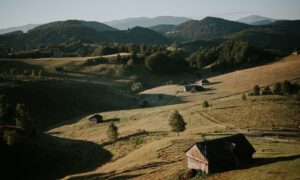
In John 4:35 (ESV), Jesus says that the fields are “white for harvest.” When wheat is ready to be harvested it turns a golden color. That changes to white before it falls to the ground, warning workers that their chance to reap what has been sown is coming to an end. Jesus is not just saying the fields are ready for harvest, but that we should feel an immediacy to act, because that won’t always be the case.

The gospel has the power to save lives, but it can only do so if it is spread in time. Today’s the time. Our missionaries confirm that over and over again as they find that young people are open and responsive to the gospel message. When we trust that God has indeed prepared the fields and will produce good fruit, we have the freedom to live into His command to work in the fields right now. And He promises when we do, He will supply and increase the results of our work (2 Corinthians 9:10).
The Harvest is Eternal

Besides being here and now, the harvest has a lasting impact. It’s worth the effort it takes to work in the fields because the fruit that comes from it is eternal.

When Jesus sent out the disciples to go to the ends of the earth and multiply, baptizing people in the name of the Father, Son, and Holy Spirit, He was telling them to work in the fields. We are the fruit of their labor and the many other faithful followers of Christ who came before us. I could grow up with parents who taught me that I am loved, because they were taught that by someone else, who was also taught that, and so on.

After more than two decades of ministry in Central and Eastern Europe, Josiah Venture is seeing disciples from the harvest equipped and trained, actively ministering to the harvest. Young people who came to know Christ through the love of our staff members are maturing in their faith and becoming leaders who are also pointing others to the love of Christ.

This work is not easy, not comfortable, not practical. It is worth it, though, because it is life-saving. Jesus came to make God known and says we should proclaim the Kingdom of God without looking back (Luke 9:62). When we do, He knows we’ll be able to rejoice together (John 4:36). And I for one, can’t wait for that!

As you remember that the harvest is here, ripe, and eternal, please pray earnestly, as Jesus told His disciples to, for more laborers. And visit our online Prayer Room to pray through requests from those already impacting the harvest here in Central and Eastern Europe.

Related Posts

Read Story

Discipleship, Evangelism, Stories

A New Generation of Missionaries

Dear Friends, “I am sending you.” —Jesus At the end of January, I spent a week with 52 new Josiah Venture missionaries at our winter Academy. Talking with them at meals and in training sessions, I was overwhelmed with the quality and passion of this next generation of missionaries. Let me briefly tell you a few of their stories. Klemen (Slovenia) trusted Christ at 16 years of age when his best friend—the son of JV missionaries—shared the gospel with him on a napkin and challenged him to put his faith in Jesus. With so few evangelical believers in Slovenia, Klemen experienced rejection from his friends and is still the only believer in his extended family. Because of his heart for young people, Klemen studied physical science and became a PE teacher but was so outspoken about his faith that the principal didn’t extend his contract. At that point, our JV staff challenged him to join the team, and he experienced God’s call into full-time ministry. Now, he is helping local churches develop outreach programs to reach the lost. Klemen’s vision? That 30% of Slovenia would become followers of Jesus. Gabriel (Romania) grew up in a Christian home as the son of a pastor. At a youth camp when he was 16, Gabe put his faith in Christ. From that point on, he spent all of his free time serving in church. He experienced God’s call into ministry at 18 and spent the next four years in theological study. However, as is typical in Romania, his church was very traditional and inward-focused. When he began to lead the youth group, there were just five attending—all from Christian families. Then, some members of the JV Romania team began to train Gabe on how to reach the lost using the tool of Fusion, a rock/gospel choir that builds community through music. Soon, the entire culture of the youth group was transformed, and unbelievers were drawn in, inviting more of their friends and coming to faith in Christ. The youth group grew to 100 in a church with just 200 members, and the entire community was impacted. Now Gabe has joined the JV team to equip other churches like his to reach the lost. “I would love for all the churches in Romania to experience this,” he said, “that the church can have an impact on the outside and share the gospel in a relevant way. That would change our country.” Kendra (Ukraine) is a second-generation JV missionary, raised on the mission field. After her graduation from Wheaton college in Illinois, she responded to God’s call to serve in a very challenging location—near the city of Kyiv, Ukraine, in the midst of war. It is a dangerous assignment for a young woman, but Kendra feels privileged to bring the light of Jesus to young people in the midst of physical darkness and great uncertainty. She learned the Ukrainian language in just 6 months, and is now experiencing open doors for ministry across her entire city. God is using her bold faith to draw many to himself. I can’t wait to see what God will do through these committed young missionaries! They can be sent because you stand with them through your prayers and generous support. Thank you. Dave Patty President, Josiah Venture

Read Story

Evangelism

The Good Shepherd

Is there hope for broken people? Between Christmas and New Year’s, I spent five days with over 100 college students from a student movement here in the Czech Republic. We dug deep into Psalm 23, learning about our Good Shepherd and how to follow him more closely. Most of the students were first-generation believers, often without a single relative who knows Jesus. Between the teaching sessions, I heard their stories, and my heart was heavy for the broken world they grew up in. Honza had very few memories of his dad, except for the unending hateful comments his mom would say about him after they divorced. Later, he realized that almost all of her relationships were broken and characterized by hate and unforgiveness. As he grew older, the hate took root in his heart, primarily directed at himself. He moved through life constantly expecting rejection. Then someone invited him to the student meetings, and he heard about a Father who loved him unconditionally and a Son who bore his sins and pain on the cross. In faith, he believed the words of Isaiah 53, that “with his stripes we are healed,” and placed his rejection and wounds on Jesus. The Good Shepherd found him, and now he is pioneering the student ministry in a new city, sharing the good news of redemption with many who have never heard. Lucy’s dad was a person with alcoholism who turned violent whenever he had too much to drink. As a small child, Lucy would cower in the corner as her dad physically abused her mom, at times fearing that her mom would not survive the beatings. He took his anger out on the kids as well, and she would go to school with bruises on her face and body. When the teachers asked what had happened, Lucy made up a story. If she told the truth, another beating would quickly follow. Lucy dreamed about running away forever, or taking her life, because her entire world was so full of danger that she had no hope. Thankfully, in university, a classmate told her about Jesus Christ and his supernatural power to change lives. The good shepherd found her and placed her in a new family. Her eyes filled with tears as she told me about the redemption she had found in Christ and the safety she found in his unending care. Katka told me she had never read the Bible and had just come to the retreat out of curiosity. She had many questions and, on the final day, asked me to sign the book she had just bought about knowing God as Father. “It’s my birthday today,” she said. I’m praying that she will be born again soon. Since the Czech Republic is the most atheistic country on earth, many young people grow up in broken families and become broken people, without hope and a way of escape. But we know the Good Shepherd. Thanks for joining us as we search for his lost sheep. Dave Patty President, Josiah Venture

Read Story

Discipleship, Evangelism, Stories

Home

Sajmir just wanted to belong. As the youngest son in a Muslim family of eight children, he was expected to serve everyone. Sajmir’s family was oppressed in Albania because they were dark skinned Gypsies. On top of that, during the difficult time after the revolution, his father began drinking and beating his mother. “My father never beat me,” Sajmir said, “but he never showed me love. He never hugged me or kissed me. I never saw a father figure. I was afraid of him. Also, outside in the city, people were not very close to me. I spent most of my time alone, playing soccer alone, or basketball alone.” There was only one soccer field in his village, and when Sajmir tried to join a game, the other kids would kick him out. One day, a group came toward the field and Sajmir began to back away, sure they would ask him to leave. “Will you play with us?” they asked. “You want to play with me?” Sajmir replied. For the first time in his life, someone invited him in. After the game, they invited him to church. “What is a church?” he said. Running home, he asked his parents if he could go. “Don’t go to church,” they answered sternly, “you will shame us.” But the next day was Sunday, and he snuck out when no one was looking. “When I stepped into the church, at the door, someone gave me a hug for the first time in my life,” Sajmir said. “They put me in the first row. I felt like a celebrity. Then I heard the story that someone loves you just as you are, that is, Jesus—as I was, dark skinned, rejected. But still, there is someone who died for me.” “I ran and told my family, but their response was: ’If you go one more time, we will tell your brother to beat you up.’ I went again. My brother beat me up. For three months, I was beaten every week. I was loved and accepted in church, while suffering and being beaten in my family. Then my mom said, ‘Let him go.’” Filled with joy, Sajmir fell on his knees and said, “God, I will serve you wherever you want me to.” That was 25 years ago, and today Sajmir and his family are part of our Josiah Venture team in Albania. Through youth ministry, he recently planted a church called “Mosaic,” which has grown to over 100 people. Every day, young people come after school and in the evening for tutoring, children’s meetings, youth meetings, small groups, discipleship groups, and a very lively Fusion choir. The church is open every day, from 9:00 am to 7:00 pm, and there is always something happening. “Our building is a daily home for everyone; it’s a family,” says Sajmir. “I always remember what God did for me in my youth. My heart is burning to see more young people come to Christ and find that they are loved and belong.” During this Advent season, we remember how Jesus left his home to make a home for us. He was sent to find us, where we play our games alone, and to invite us into his family. He found Sajmir, and you, and me. Thanks for helping us share this good news with young people who are still without a home. Dave Patty President, Josiah Venture